Anatomy of a Contract: What Each Part Is Actually For

Open any commercial agreement — a B2B service agreement, a mutual NDA, a tenancy agreement — and you will find the same skeleton underneath. The wording differs, the length differs, but the parts appear in the same order and each part is doing one specific job. Once you can name the parts, a twenty-page document stops being intimidating and becomes a checklist.
This guide takes a contract apart, section by section, and explains what each piece is for. It is about drafting craft, not about any particular area of law.
A contract is not one document — it is eight jobs
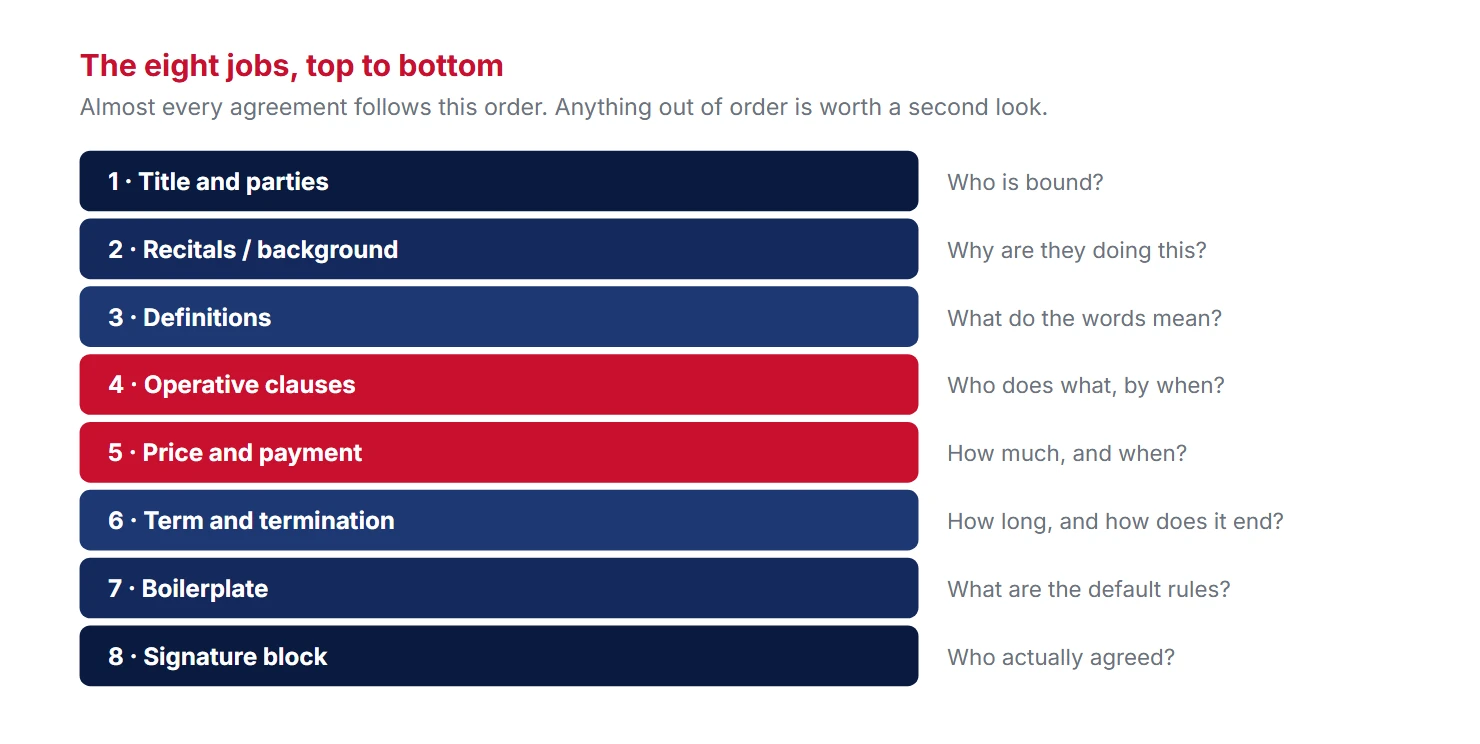
Every well-built agreement answers eight questions, in this order: who, why, what the words mean, who does what, how much, how long, what the default rules are, and who signed. Sections exist because a question needs answering. If you cannot say which of the eight a clause belongs to, that clause is probably in the wrong place.
1. The title and the parties
The title is a label, not a legal category. Calling a document a “Consultancy Agreement” does not make the relationship consultancy — the clauses do. Do not spend time on the title, and never assume the title tells you what you are signing.
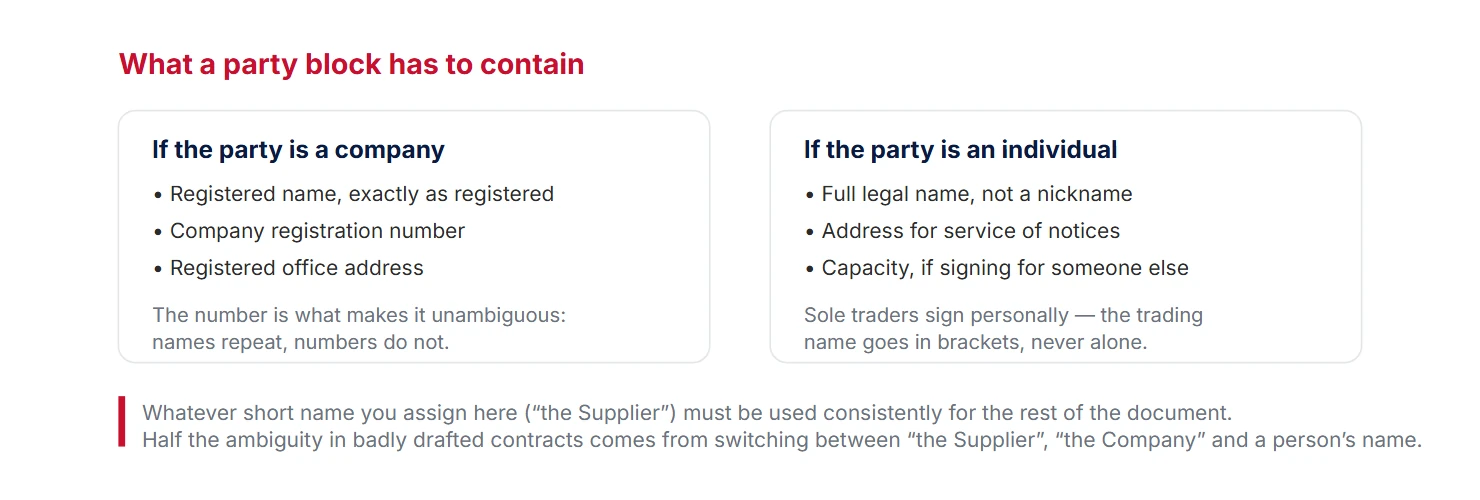
The party block is different. It is the most common place for an otherwise good contract to fail, because it is the only part that identifies who is bound. A trading name is not a legal person. “Dave’s Plumbing” is a name, not a person. Somebody stands behind it — a company, or an individual trading under that name — and that somebody is who you are actually contracting with. Name them, and put the trading name alongside.
2. Recitals: the part everyone skips
Recitals — the paragraphs that begin “WHEREAS” or sit under a “Background” heading — are not operative. They do not impose obligations. Their job is context: what the parties are, what they want, and what has already happened.
They matter more than their status suggests. When a clause turns out to be ambiguous, the recitals are the first place anyone looks for what the parties were trying to achieve. Two practical rules: keep them short, and never put an obligation in one. If a recital says a party “will provide monthly reports”, move it into the operative clauses where it can actually be enforced.
3. Definitions: a private dictionary
A defined term is a word the contract redefines for its own purposes. Once “Services” is defined, every capitalised use of “Services” means exactly that and nothing else. This is the single most powerful tool in a contract, and the easiest to break when editing a template.
- Capitalisation is meaningful. “the Services” and “the services” are two different things. If you write one where the document means the other, you have changed the deal.
- Every defined term must be used. A definition nobody refers to is dead weight and a sign the template was edited carelessly.
- Do not define the obvious. Defining “Month” as “a calendar month” adds nothing. Defining “Working Day” does, because the answer is not obvious.
- Never hide an obligation in a definition. If the definition of “Deliverables” says they must be delivered by Friday, the deadline is in the wrong section.
4. Operative clauses: who does what, by when
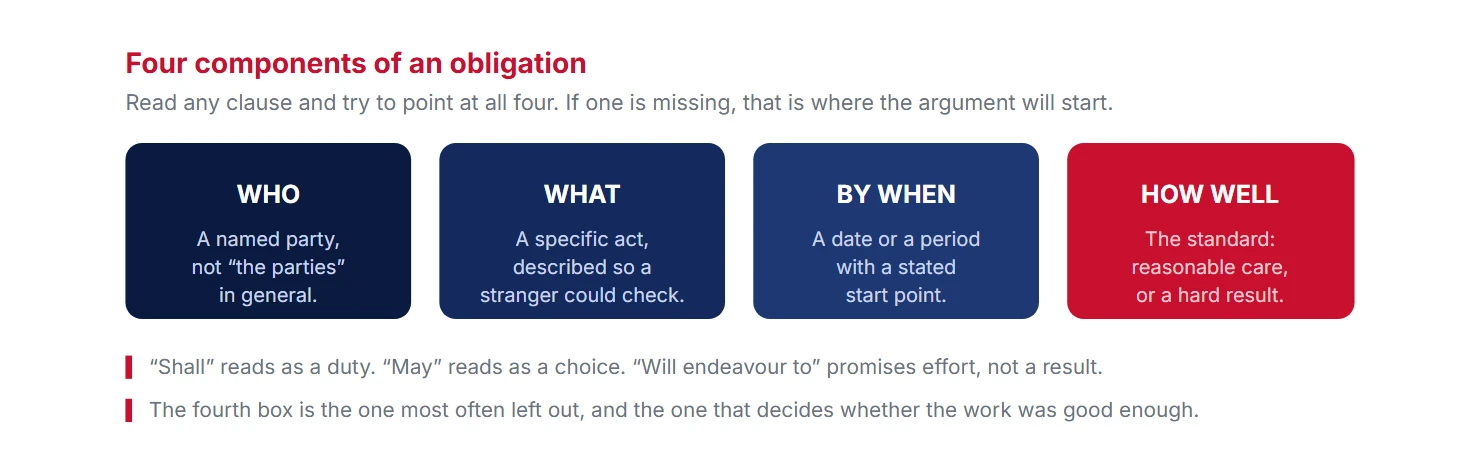
This is the deal. Everything else exists to support it. A complete obligation has four components, and the ones that cause disputes are almost always missing one of them.
5. Money: price, timing, and what happens when it is late
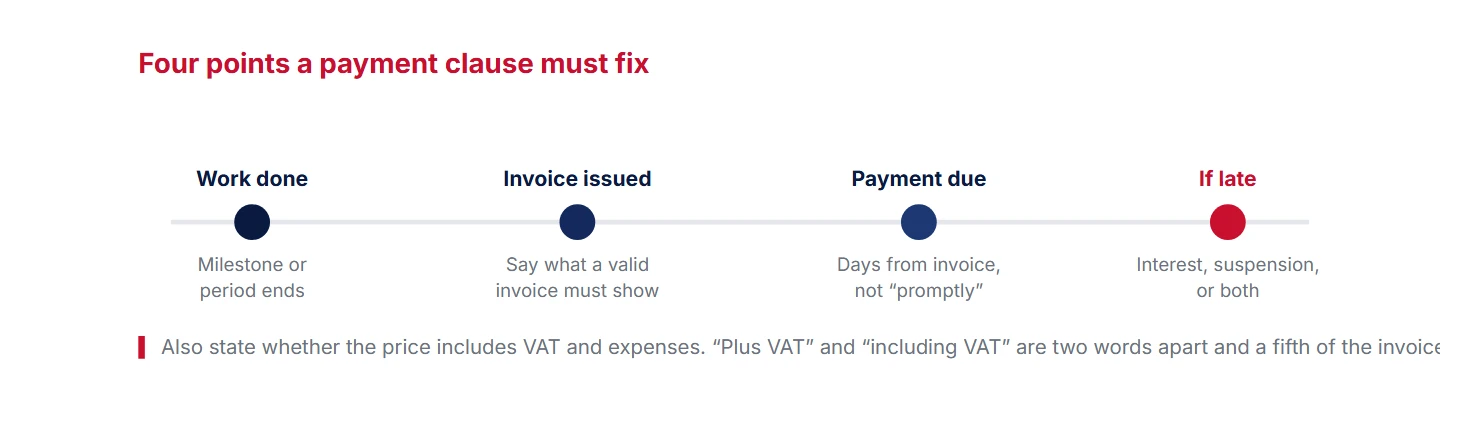
Payment clauses fail on timing far more often than on the number. “£4,000 per month” is clear. What is not clear, unless it is written down, is when the clock starts, when the money must arrive, and what happens on day thirty-one.
6. Term and termination are two different things
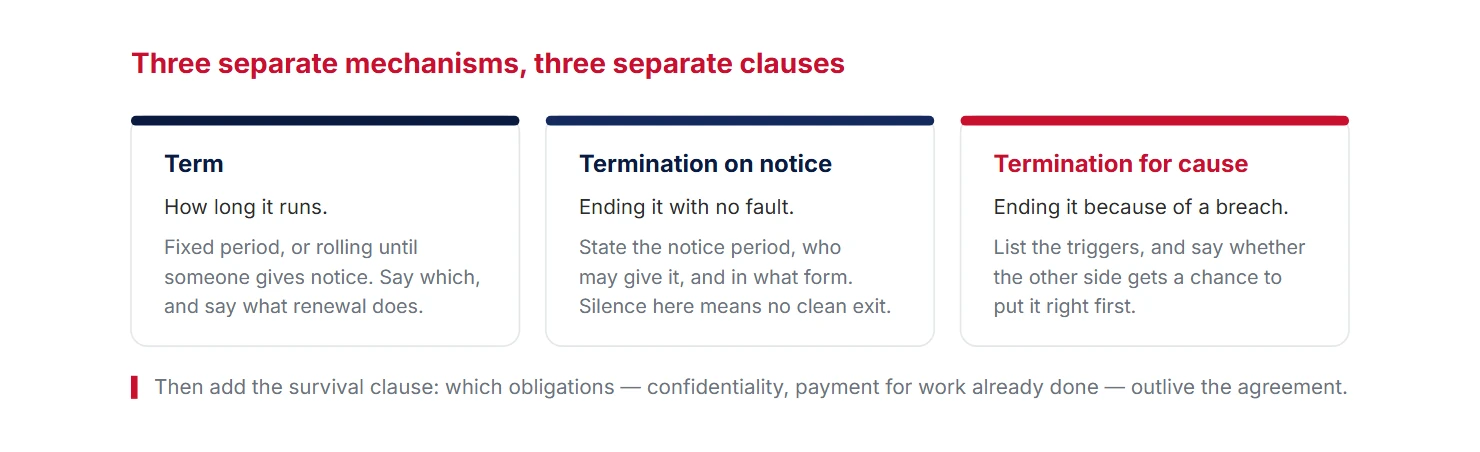
The term says how long the agreement is meant to last. Termination says how it can be brought to an end early. A surprising number of contracts define one and forget the other, which leaves a rolling arrangement nobody can exit, or a fixed period nobody can escape.
7. Boilerplate: the clauses that decide the argument
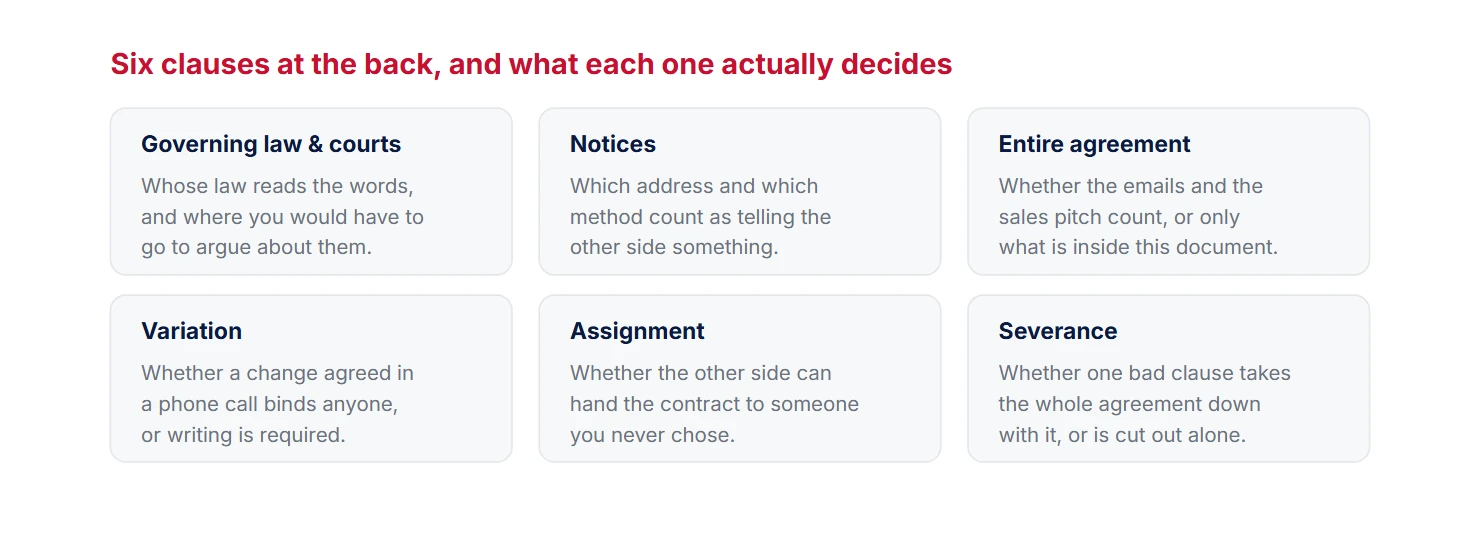
Boilerplate sits at the back and looks like filler. It is not. These clauses rarely matter until something goes wrong, at which point they decide how the disagreement is handled and often who wins it. Read them once, properly, and you will read them faster forever after.
8. The signature block
The last page carries three pieces of information: who signed, in what capacity, and on what date. Capacity is the one that is routinely dropped. Write the capacity in — “for and on behalf of” the company. A bare signature line leaves it open whether the person signed for themselves or for the company, and leaving it open is the problem, whichever way it is later resolved. Whether that signature has to be ink at all is a separate question, covered in our guide to electronic signatures.
Two more habits worth keeping. Print the name under every signature — handwriting is not evidence of identity. And leave no signature block unfilled: an agreement signed by one party and left blank by the other is not half-agreed, it is unfinished.
Reading a long contract in five minutes
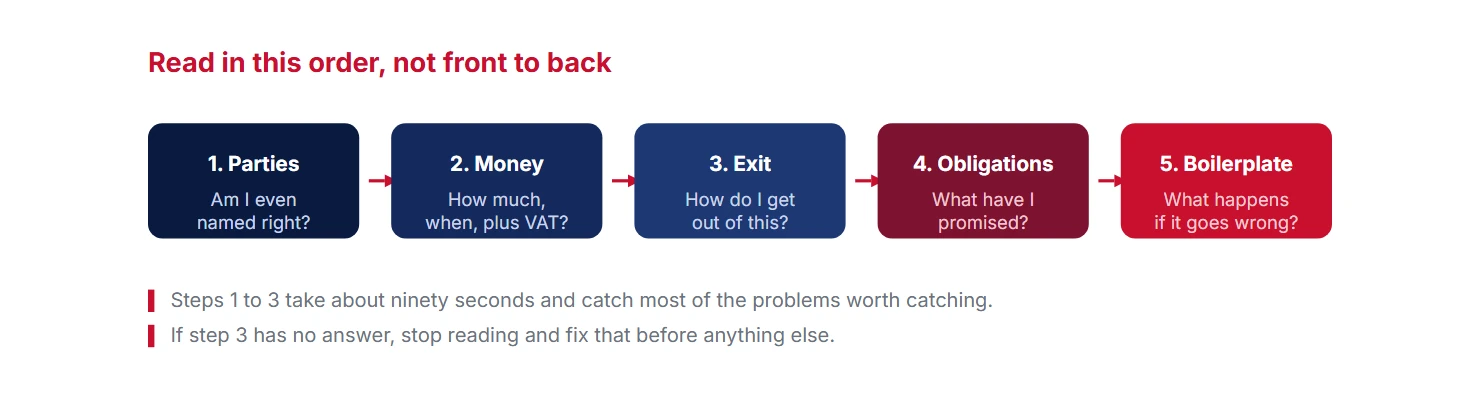
You do not have to read a contract front to back to know whether it is workable. Read it in this order instead. Each step either raises a question or clears the document to the next one.
Applying this to a template
A well-built template already has all eight parts in place, which is most of the value: the structure is the part that takes expertise, and the blanks are the part that takes ten minutes. What you supply is the commercial content — names, dates, figures, scope — and what you should never delete is a section you do not recognise. An unfamiliar boilerplate clause is not surplus; it is the part you have not needed yet.
If you want to see the skeleton in practice, three of ours show it clearly: a consultancy agreement for the full eight-part shape, a one-way NDA for a short document where definitions do most of the work, and an employment contract for one where the operative clauses dominate. Browse the whole range in the template library. Once the wording is settled, the next decision is which file to actually send: DOCX or PDF.
The short version
- The title tells you nothing. The clauses tell you everything.
- Party blocks bind people. Get the legal entity right or nothing else counts.
- Recitals explain; they do not oblige. Never hide a duty in one.
- Capitalised terms mean exactly what the definitions say — respect the capitals when editing.
- Every obligation needs who, what, by when and to what standard.
- Term, notice and cause are three different clauses.
- Boilerplate is dormant, not decorative.
- Read parties, money and exit first — ninety seconds of the five minutes.
This guide explains drafting structure and is general information, not legal advice. For a specific situation, take advice from a qualified professional.
Need a template?
Browse our 100+ document templates. Download and edit to suit your needs.
View all templates →