What Is a Power of Attorney? The Three Types Explained

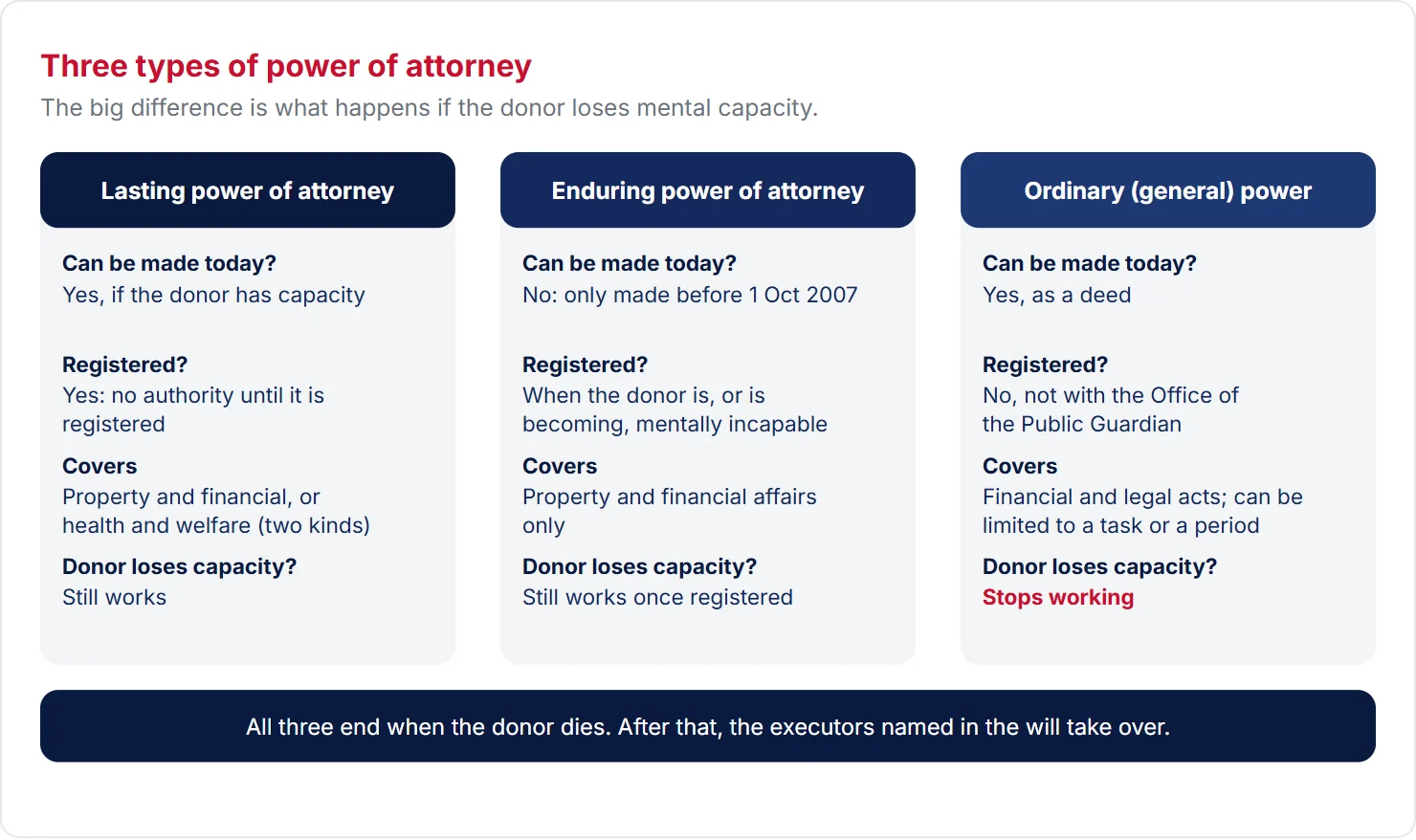
A power of attorney lets one person, the donor, give another person, the attorney, authority to act for them. The attorney may sign papers, manage money, or take certain decisions on the donor’s behalf. England and Wales have three types: the lasting power of attorney, the older enduring power of attorney, and the ordinary (general) power of attorney.
The question that matters most is what happens if the donor loses mental capacity. A lasting power of attorney is built to keep working. An ordinary one stops. Each type ends when the donor dies. This guide covers England and Wales only; Scotland and Northern Ireland run their own systems.
What is a power of attorney, and what are the three types?
Think of it as lending someone your signature for a set purpose. The donor stays in charge for as long as they can; the attorney steps in only where the document allows. What separates the three types is when they can be made, whether registration is required, and what becomes of them if the donor loses capacity.
Lasting power of attorney (LPA)
An LPA lets the donor grant one or more attorneys authority to make decisions, including once the donor no longer has mental capacity. Two kinds exist, each a separate document: one for property and financial affairs and one for health and welfare. To sign, the donor must be 18 or over and have capacity. Until it is registered with the Office of the Public Guardian, an LPA does not exist, and an unregistered LPA gives the attorney no authority at all. For the basics of LPAs alongside wills, see our wills and lasting powers of attorney guide.
A health and welfare LPA can be used only when the donor lacks capacity for the decision in question, or the attorney reasonably believes they do. Consent to treatment, or refusal of it, can fall within it. Life-sustaining treatment is covered only where the LPA expressly says so.
Enduring power of attorney (EPA)
An EPA could only be made before 1 October 2007. If you or a relative made one before then, it still works. Property and financial affairs are all it covers. Once the attorney believes the donor is, or is becoming, mentally incapable, the attorney must apply to register it with the Office of the Public Guardian. Until registration, the attorney can carry out only limited acts, such as maintaining the donor and preventing loss to the estate.
Ordinary (general) power of attorney
An ordinary power of attorney is governed by the Powers of Attorney Act 1971 and must be made as a deed. In its statutory form it gives the attorney authority to do anything the donor can lawfully do by an attorney, which means financial and legal matters. It does not cover the donor’s functions as a trustee or personal representative. Nor is it registered with the Office of the Public Guardian, and it stops working if the donor loses mental capacity. It can be limited to specific acts, or to a period.
Who can be an attorney?
An attorney must be 18 or over. Past that, the rules depend on which kind of LPA it is:
- Someone who is bankrupt, or who has a debt relief order, cannot be appointed as attorney for property and financial affairs.
- A trust corporation can be an attorney only for property and financial affairs, never for health and welfare.
- The donor may name replacement attorneys, but an attorney cannot appoint a substitute of their own.
Pick someone you trust to follow your wishes, and think about naming a replacement in case your first choice cannot act.
Who can witness a power of attorney?
With an LPA, the order of signatures matters. The donor reads the information and signs in front of a witness. The certificate provider signs next. Then each attorney signs, again in front of a witness. Every witness signs and gives their full name and address. Where someone signs on the donor’s behalf, two witnesses are needed.
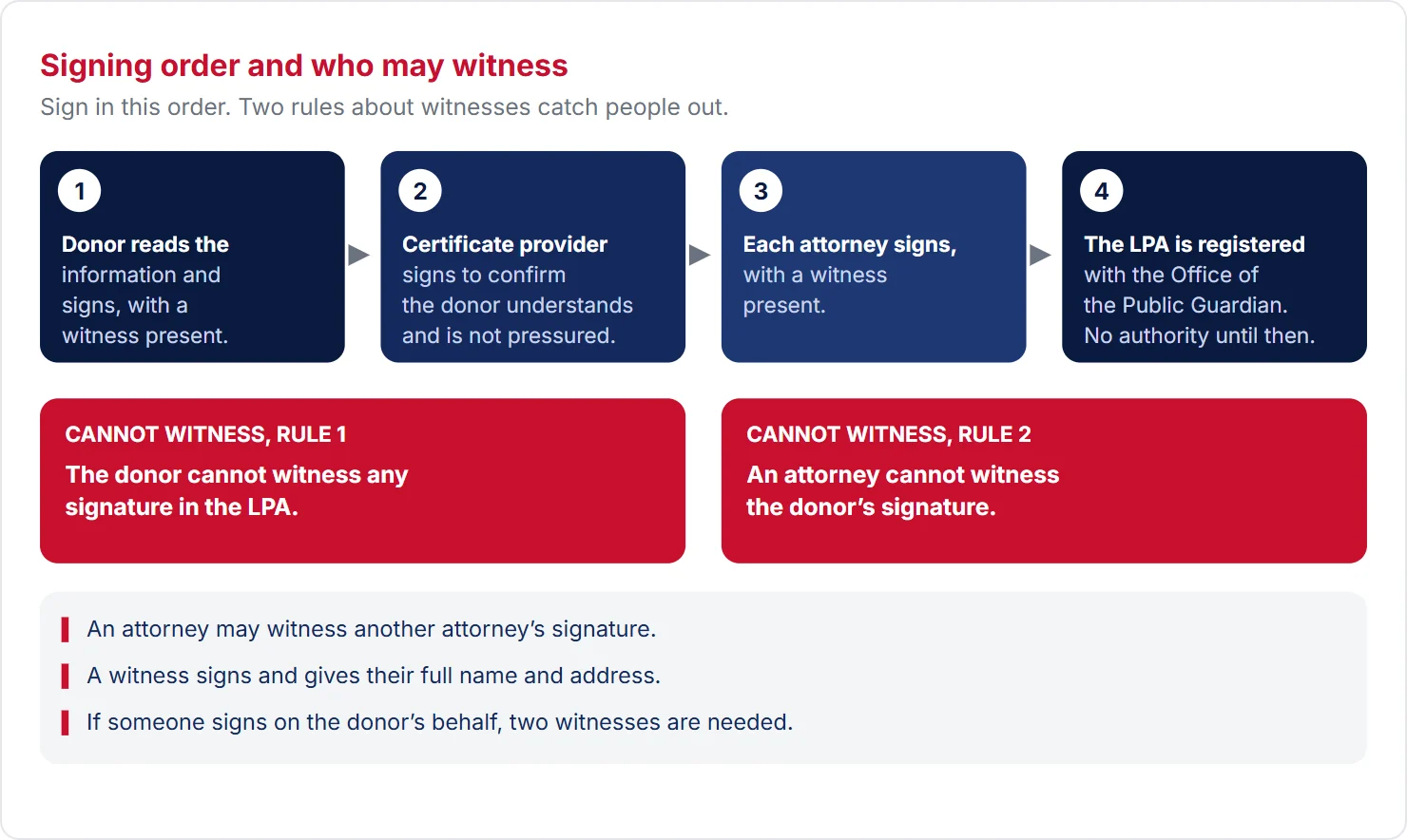
Two rules catch people out. A donor cannot witness any signature in the LPA, and an attorney cannot witness the donor’s signature. One attorney can, though, witness another attorney’s signature.
Take Margaret. She names her daughter Sunita and her son Daniel as attorneys. Sunita cannot witness Margaret’s signature because she is an attorney, and nor can Daniel. Sunita could witness Daniel’s signature, but Margaret could not witness anyone’s. For the donor’s signature, the simplest choice is a neighbour or friend who is neither the donor nor an attorney. So when people ask whether a family member or spouse can witness, the real question is whether that person is the donor or an attorney. The family tie on its own does not decide it.
These witnessing rules apply to an LPA. An ordinary power of attorney is a deed, so follow the signing instructions supplied with your template.
What is the certificate provider on a power of attorney?
Every LPA needs a certificate provider. This is someone who confirms that the donor understands the LPA, that the donor is not under pressure or being defrauded, and that nothing else prevents the donor from making it. The role is a safeguard. It does not make the certificate provider an attorney.
A certificate provider must be in one of two groups: someone who has known the donor personally for at least two years, or someone with relevant professional skills. That includes a doctor or other registered health professional, a solicitor or barrister, a registered social worker, or an independent mental capacity advocate.
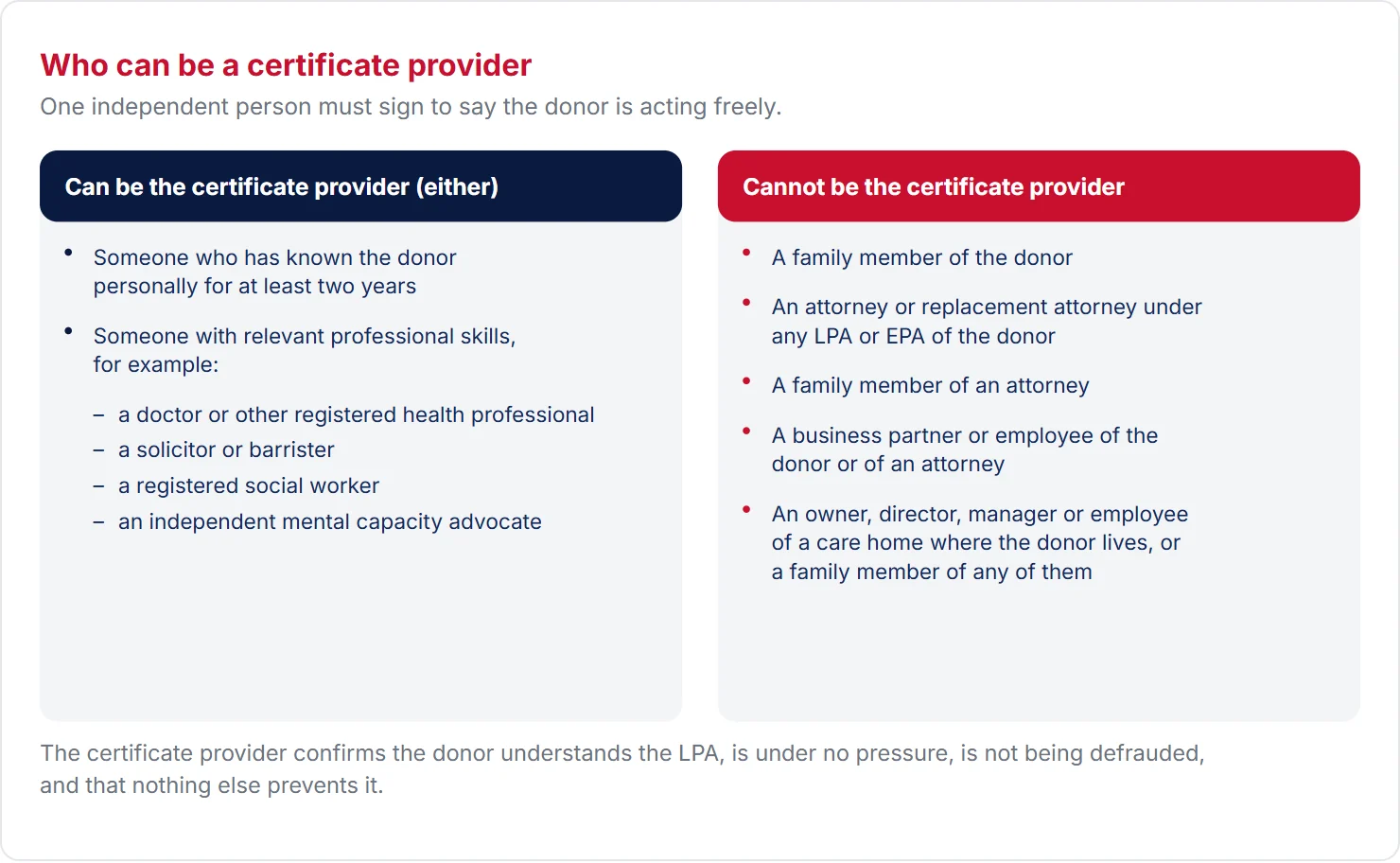
Some people are barred from the role. A certificate provider cannot be: a family member of the donor; an attorney or replacement attorney under this or any other LPA or EPA of the donor; a family member of an attorney; a business partner or employee of the donor or of an attorney; or an owner, director, manager or employee of a care home where the donor lives (or their family member).
Take Priya, who is making an LPA. She has known her next-door neighbour Helen for ten years. Helen is not related to Priya or to either attorney, and she is not their employee or business partner, so she qualifies through the “known personally for at least two years” route. Priya’s sister would not qualify.
Jointly or jointly and severally: how should attorneys act?
With two or more attorneys, the donor chooses how they act:
- Jointly: every attorney must agree on everything.
- Jointly and severally: any attorney can act alone.
- A mix: jointly for some decisions and jointly and severally for others.
If the LPA does not say, the attorneys must act jointly. That default can be awkward: if Sunita and Daniel always have to agree, one of them being abroad or unwell can hold up even a simple bill payment. Jointly and severally is more flexible, while joint action gives more oversight. Neither is wrong. Choose the option that fits how far you trust each person to act alone. (This is a different matter from joint tenants who co-own a home; our guide to tenants in common and joint tenants covers that.)
Does a power of attorney end at death?
Yes. Every power of attorney ends when the donor dies, whether it is lasting, enduring or ordinary. The attorney can no longer act under it, however long they have been looking after the donor’s affairs. From then on, the executors named in the will, or administrators if there is no will, deal with the estate.
A lasting power of attorney can also end earlier. The donor can revoke it at any time while they have capacity. A property and financial affairs LPA is also revoked by the donor’s bankruptcy. An attorney’s appointment ends on their death, bankruptcy (property side only), disclaimer, loss of capacity, or divorce or dissolution of a civil partnership from the donor, unless the LPA says otherwise. If that attorney was the only one and no replacement is named, the LPA ends.
The practical point: a power of attorney is for life, a will is for death, and neither does the other’s job. If you have an attorney managing your affairs, you still need a will so your executors know what to do next. Our Last Will and Testament template names executors and sets out the wishes they will follow.
Last Will and Testament
It names the executors who step in once any power of attorney ends at death. This is a will, not a power of attorney.
View template →When does an ordinary power of attorney make sense?
It works for a set task or a limited time, provided you expect to keep your capacity throughout. Common examples include a spell abroad, a hospital stay, selling a house while you are away, or another short-term need. Keeping it to specific acts or a fixed period leaves the attorney’s authority tightly bounded.
Example: Callum is working overseas for six months and wants his brother Ravi to handle the sale of his flat. An ordinary power of attorney, limited to that sale and that period, suits the job exactly. It does not need registration with the Office of the Public Guardian.
Be clear about what it cannot do. It is not an LPA, and if Callum lost capacity, it would stop working. If your concern is future illness or dementia, you need an LPA instead. If you want an ordinary power of attorney for a specific job, see our General Power of Attorney.
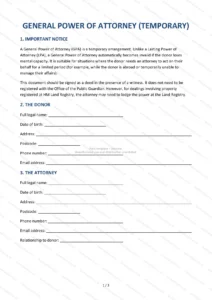
General Power of Attorney
An ordinary power of attorney, not an LPA. It is not registered, and it ends if the donor loses mental capacity.
View template →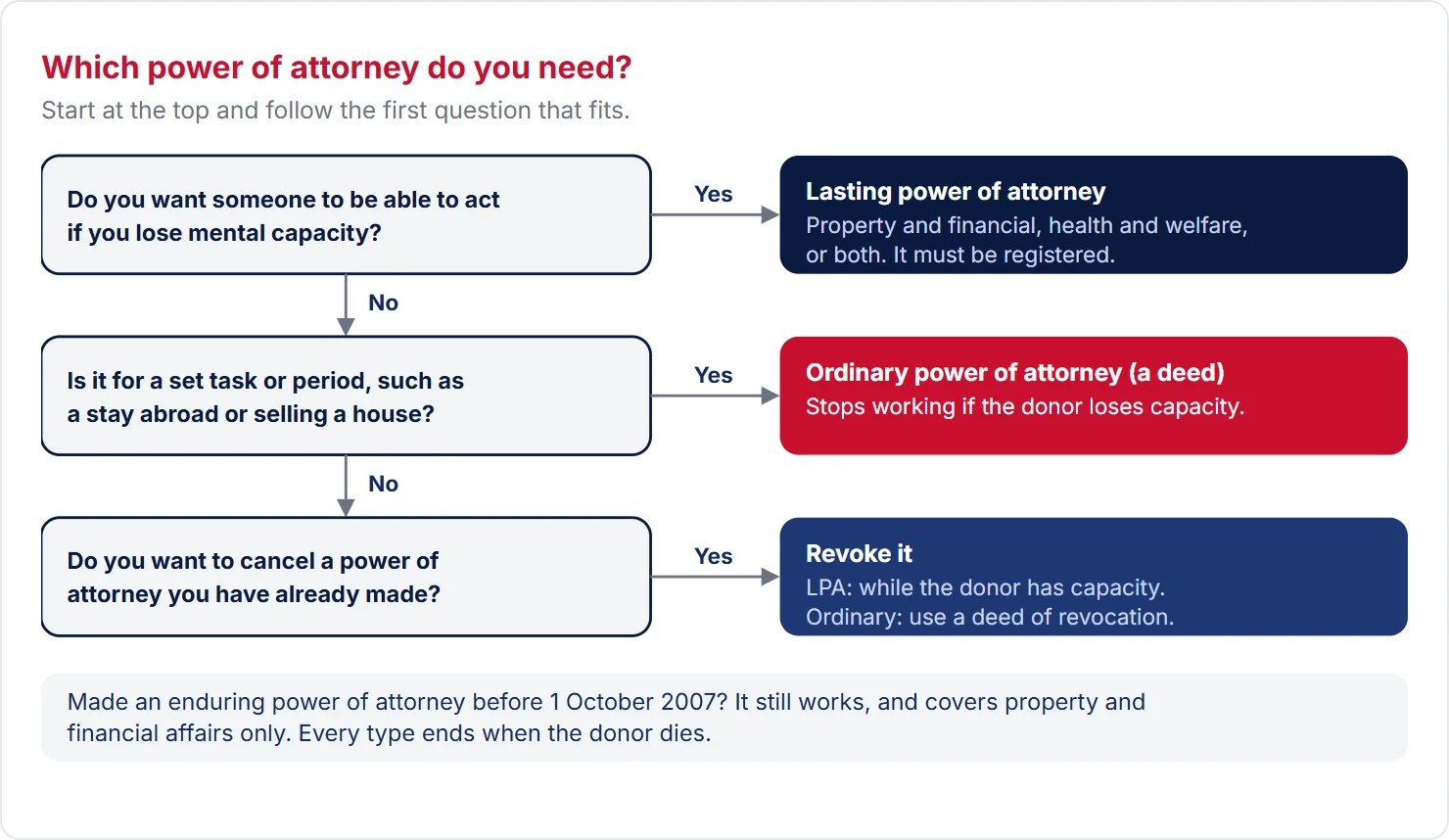
If you are still weighing options, browse the full list of templates to see what else the range includes.
What does revoking a power of attorney involve?
Revoking means cancelling the authority you gave. With an LPA, the donor can do that at any time while they have capacity. Tell the attorney or attorneys straight away.
For an ordinary power of attorney, a deed of revocation is the tidiest route. It records that the authority is cancelled, either in full or for one named attorney, and that the attorney has been told. The last step is often missed: tell everyone who has been dealing with the attorney, such as a bank or a solicitor, so that nobody keeps relying on a document that no longer has effect. Our Deed of Revocation of Power of Attorney covers that record.
I, Priya Shah, revoke the power of attorney I made on [date] in favour of Tom Barker, with effect from today.
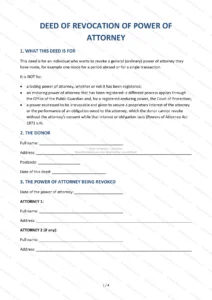
Deed of Revocation of Power of Attorney
A deed that revokes an ordinary power of attorney, either in full or for one attorney, and records who has been told.
View template →If you have an enduring or registered lasting power of attorney and are unsure how to end it, ask the Office of the Public Guardian before you act.
Quick checklist
- Do you need authority that survives loss of capacity? Make an LPA and register it.
- Only for a task or a time limit? An ordinary power of attorney, made as a deed, may be enough.
- If you made an EPA before 1 October 2007, it still works; the attorney registers it once they believe the donor is losing capacity.
- Witnesses: the donor never witnesses; an attorney never witnesses the donor.
- Certificate provider: someone who has known you for at least two years, or a relevant professional; never family or an attorney.
- More than one attorney? State whether they act jointly, jointly and severally, or a mix. If the LPA is silent, they act jointly.
- Any power of attorney ends at death; then your will and executors take over.
Need a template?
Browse our 100+ document templates. Download and edit to suit your needs.
View all templates →