Self-Certification for Sickness: The 7-Day Rule Explained
Self-certification is your own statement to your employer that you were ill when you have no medical evidence: you say, in your own words, that you were sick and for which days. It covers the first seven days of a spell of sickness. This guide covers England and Wales. The statutory sick pay rules it mentions apply across Great Britain.
Those seven days are calendar days, so weekends count. From day eight, your employer can ask for a fit note. Self-certification, though, is only about evidence. Whether you are paid, and how much, is a separate question that depends on statutory sick pay and your contract. Both come up below, for the employee who is off sick and the small employer who has to manage the absence.
What is self-certification for sickness?
A spell of sickness is a continuous period of being ill. During the first seven days of a spell, an employer cannot require medical evidence, meaning a fit note, for statutory sick pay purposes. The employee self-certifies instead by telling the employer they are sick. The employer may ask for that statement in writing.
In practice, that means either a form the employer has made up itself or the HMRC form SC2, called the Employee’s statement of sickness. Others accept an email or a message in an HR system. The idea is the same in each case: you give the dates and a short account of why you could not work, and you sign or confirm that it is true.
Be clear about what it does not do. Self-certifying does not decide your pay, and it does not excuse you from your employer’s reporting rule. It is only the evidence step.
How many days can you self-certify, and do weekends count?
You self-certify for up to seven days. They are calendar days, so Saturdays, Sundays and any other days you would not normally work all count towards the seven. If you are ill from a Friday, the weekend uses up days two and three before you have missed a working day.
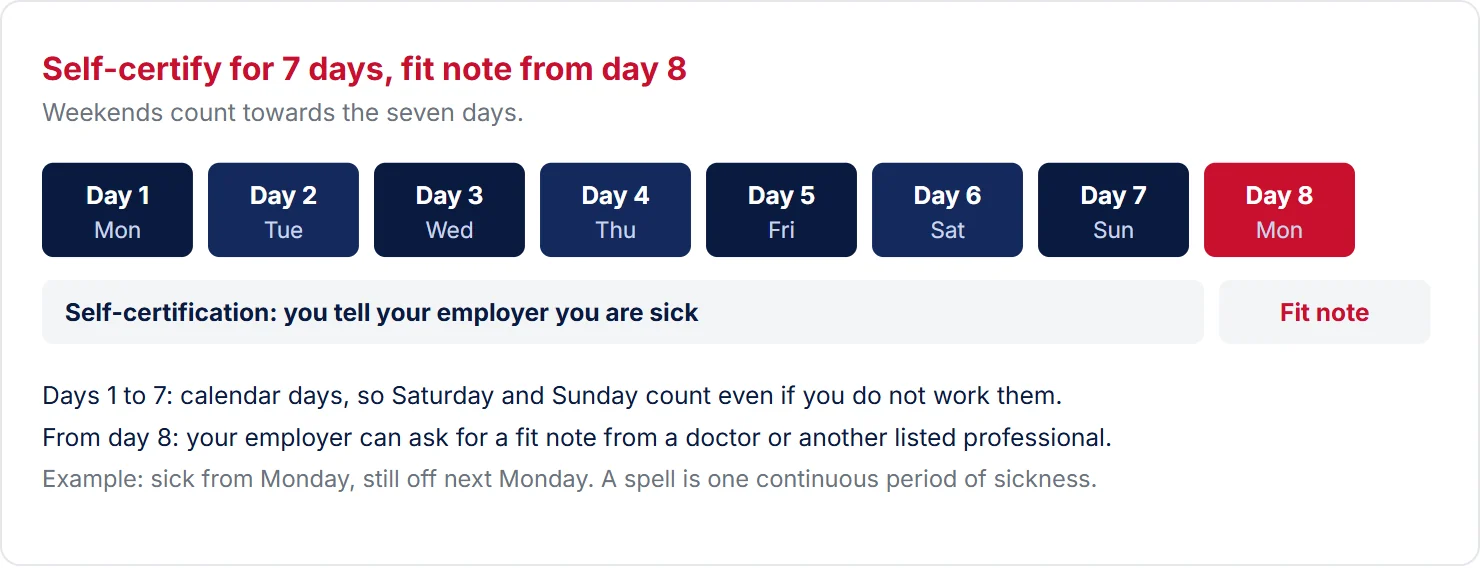
Once day eight arrives, the employer can ask for a fit note, formally a statement of fitness for work. Until then it can ask for your own statement, but not for a doctor’s note.
A spell, day by day
Amira works Monday to Friday. She wakes up with flu on a Wednesday and cannot work. Here is how her spell is counted:
- Wednesday counts as day 1, Thursday as day 2 and Friday as day 3.
- Saturday counts as day 4 and Sunday as day 5, even though she does not work either.
- Monday is day 6 and Tuesday day 7. Her employer can ask for a self-certification form covering all seven days.
- The following Wednesday is day 8. If she is still off, her employer can ask for a fit note.
If Amira is better by the Monday and returns to work, the spell lasts seven days or fewer, so a self-certification is all the evidence her employer can ask for.
What goes on a self-certification form?
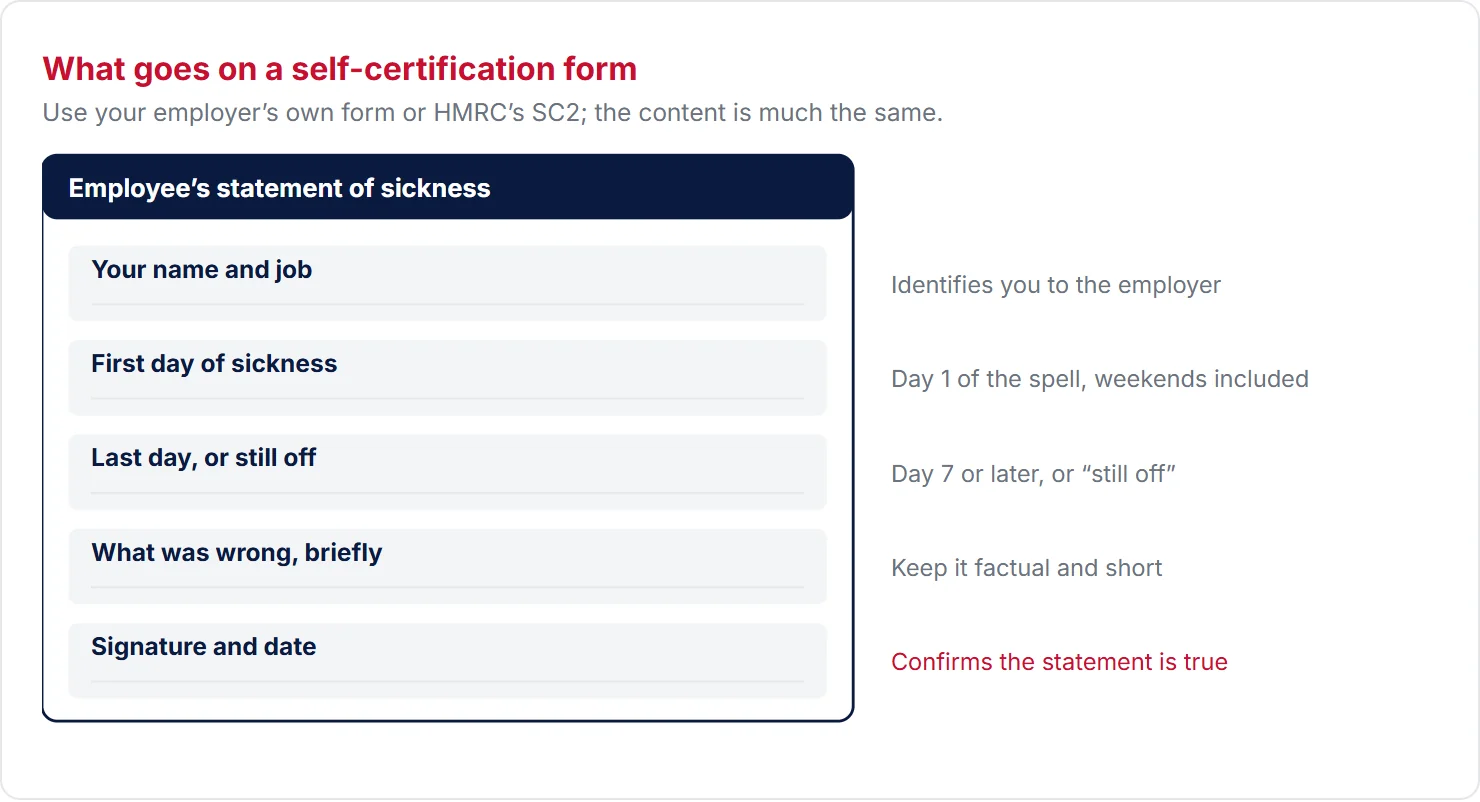
Your employer’s form and the SC2 ask for broadly the same details: who you are, the first day you were sick, the last day (or that you are still off), a brief description of what was wrong, and your signature and the date. The dates matter most, because they set the length of the spell. Keep the description short and factual. You do not need to give a full medical history.
If no form is available, plain wording will do. Something like this works:
I, Amira Hassan, was unable to work because of illness (flu) from Wednesday 4 November to Tuesday 10 November, both days included. I returned to work on Wednesday 11 November. I confirm that this statement is true. Signed: A. Hassan. Date: 11 November.
Change the names, dates and reason to suit your case. If you are still off, write “and remain unwell” in place of a return date, and send an updated statement or a fit note when you can.
When do you need a fit note, and who can issue one?
If your employer asks for a fit note, you need one from day eight, and it does not have to come from a doctor. A doctor can issue it, and so can a registered nurse, occupational therapist, physiotherapist or pharmacist. Ask whoever is treating you whether they can issue one.
After the seventh calendar day, employers can ask for a fit note, though they do not have to, and a short, well-understood spell may not need one. For statutory sick pay, you cannot insist on medical evidence for the first seven days.
Reporting sickness: how and when?
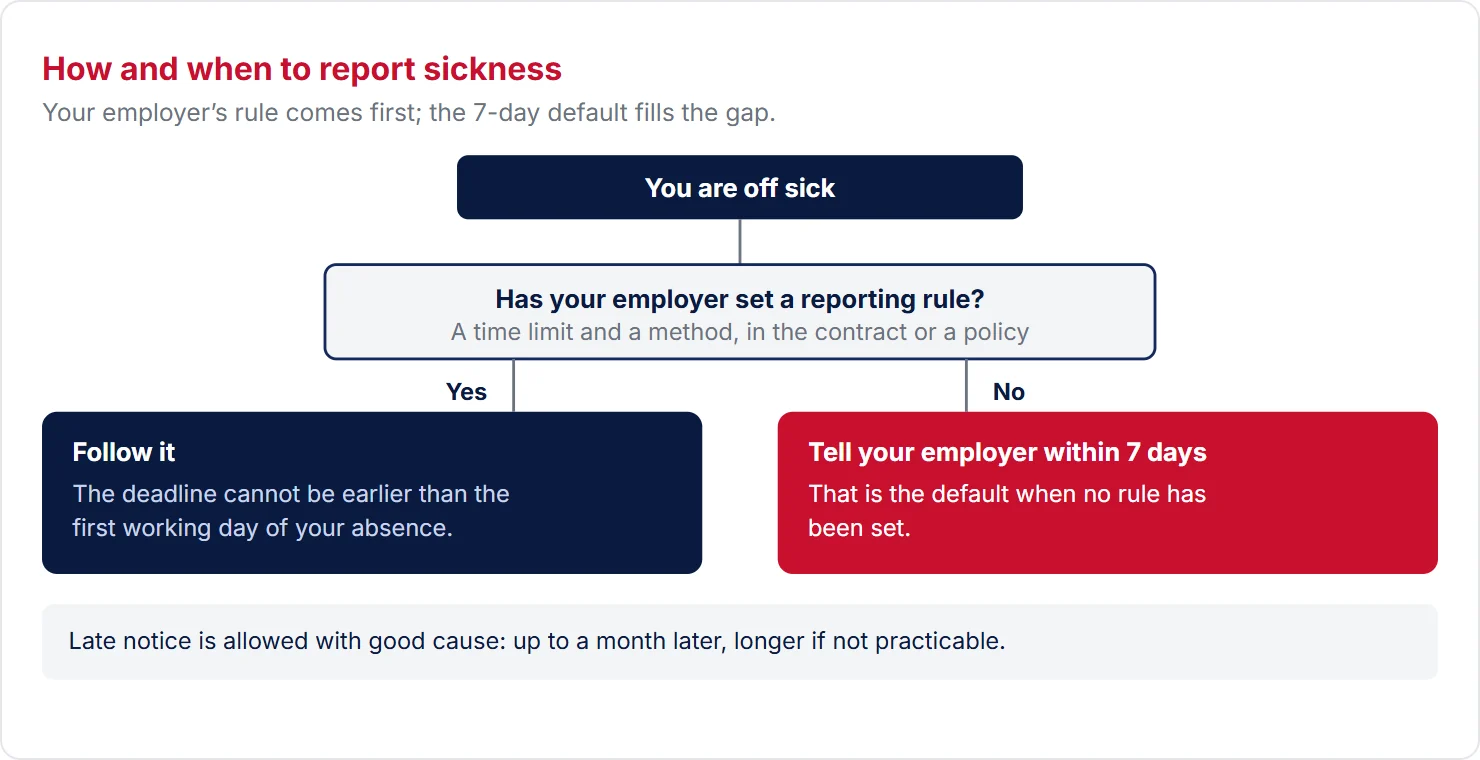
Reporting an absence is not the same as self-certifying. The employer sets the rules on reporting: it may choose a time limit and a method, such as ringing your manager before the shift begins. It must take reasonable steps to tell employees about the rule, for instance by putting it in the contract or a sickness policy. It cannot, though, require notice earlier than the first working day of the absence.
Where your employer has set no rule, you must tell them within seven days. Late notice can still be allowed: up to a month later where there is good cause, and longer where giving notice sooner was not practicable.
Setting a reporting rule when you are the employer
A rule only works if people know about it. Put the time limit and the method in writing, in the contract or the sickness policy, and say who the employee should contact. A clear rule also protects you: when someone does not follow it, you can point to what they were told. The sickness section of an employment contract is the natural place for it, and the employment contract guide explains how the written terms fit together. If you need the document itself, the full-time template below has space for both the reporting rule and the sick pay terms.
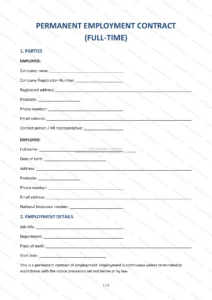
Full-Time Employment Contract
A full-time employment contract for employers in England and Wales, where you record your sickness reporting rule and sick pay terms.
View template →How does statutory sick pay work in 2026?
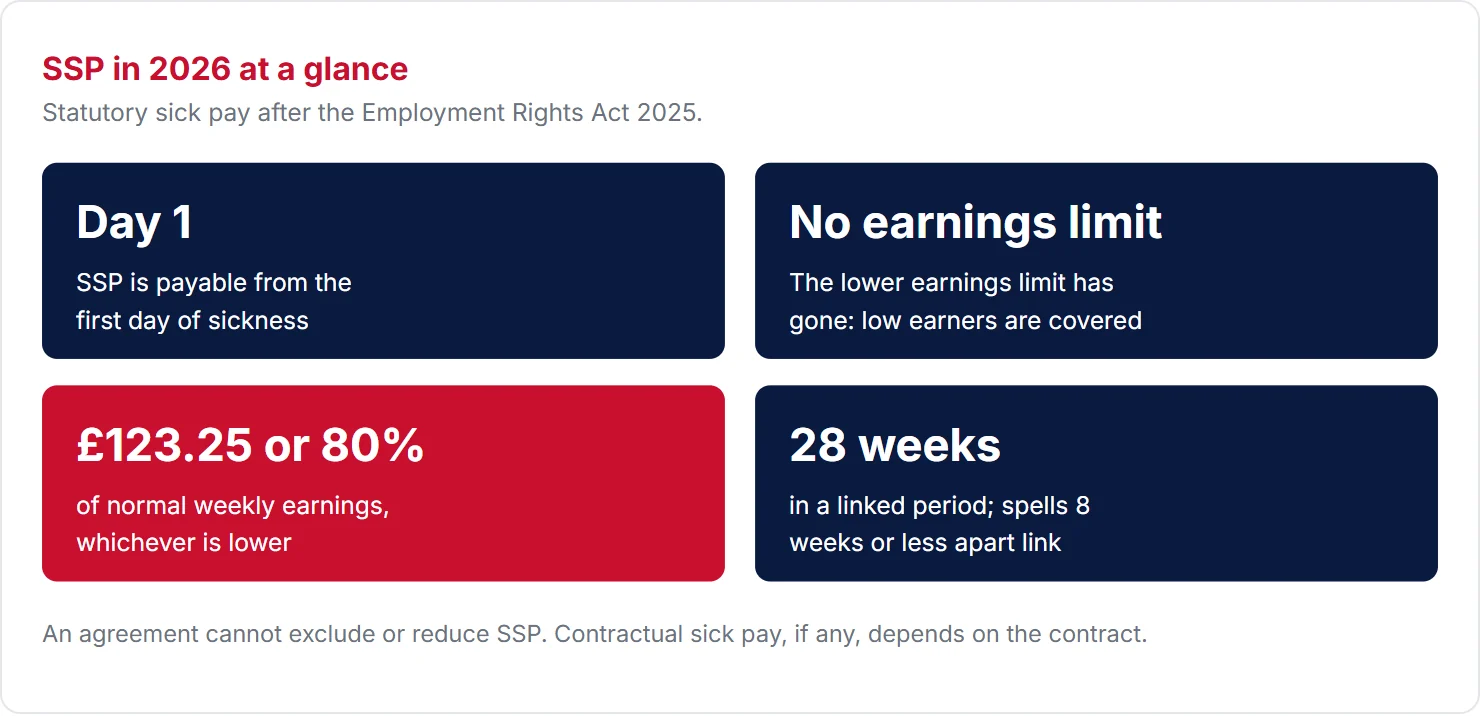
Statutory sick pay (SSP) is the minimum an employer must pay a sick employee who qualifies. The Employment Rights Act 2025 changed the rules, and our Employment Rights Act 2025 timeline sets out the stages. As things stand in 2026:
- SSP is payable from the first day of sickness, because the three waiting days have gone.
- There is no lower earnings limit, so low earners are no longer left out.
- The weekly rate is £123.25, or 80% of the employee’s normal weekly earnings, whichever is lower.
- It is paid for up to 28 weeks in a linked period.
- An agreement cannot exclude or reduce SSP.
When do two spells link?
One day of sickness counts as a spell in its own right. Two spells separated by eight weeks or less are linked into one. The 28 weeks run across the whole linked period, so a recurring illness does not restart the clock every time you come back for a few days.
Take Tom. He is off for ten days, returns to work, and falls ill again five weeks later. The gap is under eight weeks, so the two spells form one linked period, and his second absence counts towards the same 28 weeks.
Is self-certification the same as getting sick pay?
No, and this is the point people most often get wrong. Self-certification answers one question: can the employee show they were ill? Pay answers another: what does the employer owe them? That depends on SSP, which is the floor, and on whatever the employment contract or company policy promises on top. Some employers pay full pay for a set period; others pay SSP only.
That is why the sickness section of a contract matters, and why a vague one causes arguments. If you are an employee, check your contract or staff handbook before you assume you will receive full pay. If you are an employer, decide what you offer and write it down. The Part-Time Employment Contract is built for pro-rata staff, and the Zero Hours Contract is for casual workers with no minimum hours. Both give you a written document that sets out your terms, including how sickness is reported and paid, so nothing is left to guesswork.
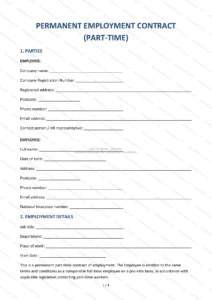
Part-Time Employment Contract
A part-time contract for employers in England and Wales, with pro-rata pay and holiday, and room to set out your sickness terms in writing.
View template →How should employees and employers handle this?
When you are off sick
- Follow the rule your employer sets for how and when to report it. If no rule exists, report it within seven days. Earlier is better.
- Make a note of the first day you were ill, then record every day you are off, weekends included.
- When asked, fill in your employer’s form or the SC2, then sign it.
- Still ill after day seven? Get a fit note from a doctor or another healthcare professional who is listed.
- Look at your contract for any sick pay on top of SSP.
If you are the employer
- Put your reporting rule in the contract or policy. Give it a time limit and a method.
- Do not ask for a fit note during the first seven days of a spell.
- Offer a self-certification form, either your own or the SC2, and keep every one on file.
- Count days as calendar days, weekends included. Link spells that are eight weeks apart or less.
- Pay SSP from day one with no lower earnings limit. Set out clearly any sick pay above SSP.
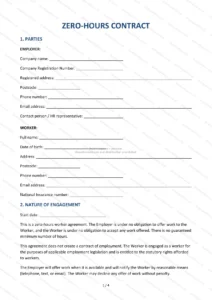
Zero Hours Contract
A zero hours contract for casual staff with no minimum hours. It records how sickness is reported and what you will pay.
View template →Putting together a set of employment documents? Browse the full range in the template shop. A long illness may also raise the question of who could manage your affairs; our guide to what a power of attorney is is a sensible place to start.
Quick summary
- Self-certification covers the first seven calendar days of a spell. Weekends count.
- The employer can ask for it, using its own form or HMRC’s SC2.
- From day eight, the employer can ask for a fit note. A doctor, or another professional on the list, can issue it.
- The employer can set a time limit and a method for reporting sickness. If no rule exists, tell them within seven days.
- SSP in 2026 is payable from day one, with no lower earnings limit. The rate is £123.25 or 80% of normal weekly earnings, whichever is lower, and it is paid for up to 28 weeks.
- Self-certification is evidence. Your pay depends on SSP and your contract.
This guide gives general information for England and Wales. It is not advice on your particular case. If a dispute arises over pay or dismissal, get advice before you act.
Need a template?
Browse our 100+ document templates. Download and edit to suit your needs.
View all templates →