Tenants in common vs joint tenants: what’s the difference?

Joint tenants hold a home as a single unit, with no separate shares, and when one owner dies the survivor automatically takes the lot. Tenants in common each own a share instead, sometimes unequal, and that share passes under the owner’s will rather than to the co-owner. That is the core difference, and it matters most when someone dies or the owners fall out.
This guide covers England and Wales. It deals with owning a home with someone else, not renting one; if it is a rental tenancy you are after, see our tenancy agreement guide. Here you will find how the two kinds of co-ownership differ, how to switch between them, and what to write down so nobody is left guessing.
What is the difference between joint tenants and tenants in common?
In England and Wales the legal title to a co-owned home is always held by the owners as joint tenants, as trustees. That may sound odd if you plan to be tenants in common, but the legal title is only the paperwork. What differs is how you own the beneficial interest, which is the real value of the property. You hold it either as beneficial joint tenants or as tenants in common.
As joint tenants, you own the whole property together. Nobody holds a 50% or 70% share; there are no shares at all. As tenants in common, each of you owns a defined share. Shares can be equal or unequal, such as 60/40, and each owner can leave their share by will.
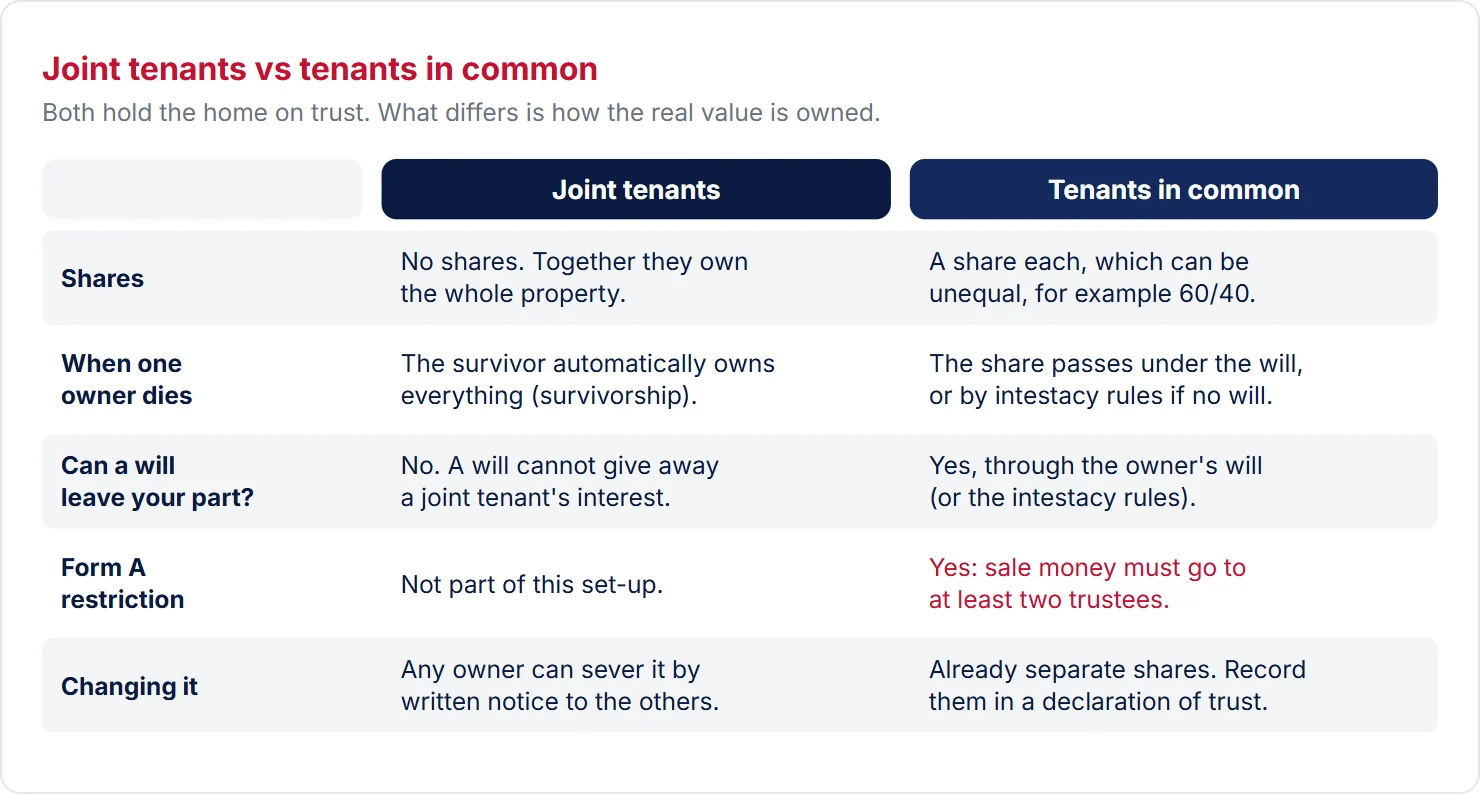
One way to keep it straight: joint tenants share a single pot, while tenants in common each own a slice of it.
What happens when one owner dies?
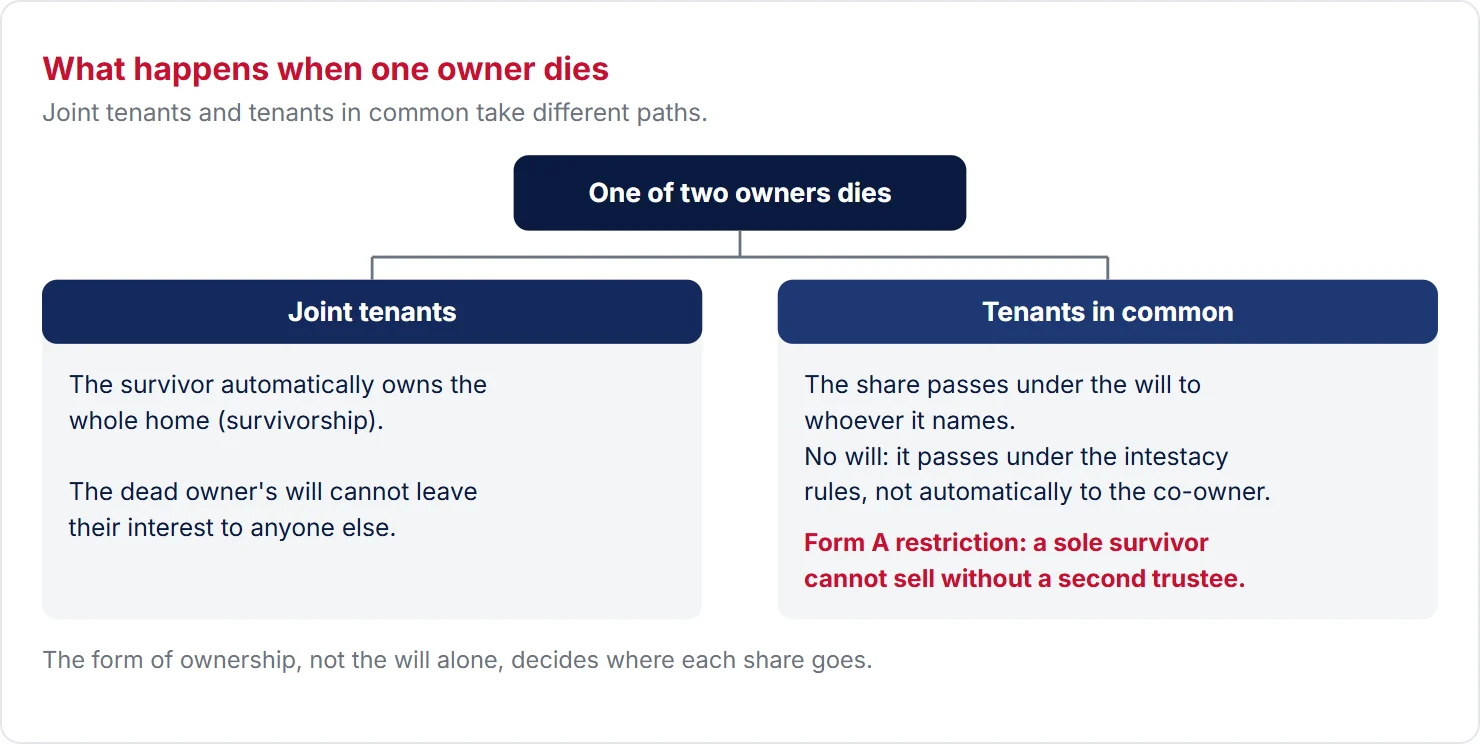
This is where the two routes part company, and it is the question most couples and friends overlook when they buy.
Joint tenants: the survivor takes everything
When one joint tenant dies, the survivor automatically owns the whole property. This is known as survivorship. It happens whatever the will says: a will cannot leave a joint tenant’s interest to anyone else. For a couple who want the survivor to keep the home without fuss, that can work well.
Tenants in common: the share goes under the will
When a tenant in common dies, their share passes under their will. Without a will, it passes under the intestacy rules, which decide who inherits. It does not go automatically to the co-owner. That helps if you want your share to reach your children, a parent or a sibling, but it works only if you have actually made a will.
Last Will and Testament
Tenants in common need a will for their share; this template covers executors, bequests and two-witness signing.
View template →Priya and Tom, who buy a flat as tenants in common, show how this plays out. If Tom dies with a will leaving his share to his daughter, she becomes a co-owner with Priya. If Tom dies without a will, the intestacy rules decide who inherits his share, and Priya does not inherit it automatically. For the wider picture on wills, see our guide to wills and lasting powers of attorney.
Can tenants in common own unequal shares?
Yes. Tenants in common can hold equal or unequal shares, and unequal shares are the main reason people pick this route. Typical situations include:
- one buyer puts in a larger deposit than the other;
- a parent helps a child buy and wants their contribution recognised;
- friends or siblings buy together and pay different amounts;
- one partner has children from an earlier relationship and wants their share to go to them.
Here is how that works in practice. Priya puts in more of the money, so she and Tom agree to hold the flat 70/30. Years later they sell, and after the mortgage and costs are paid there is £200,000 left. Priya receives £140,000 and Tom £60,000. These figures are illustrative only, but they show why the shares should be written down.
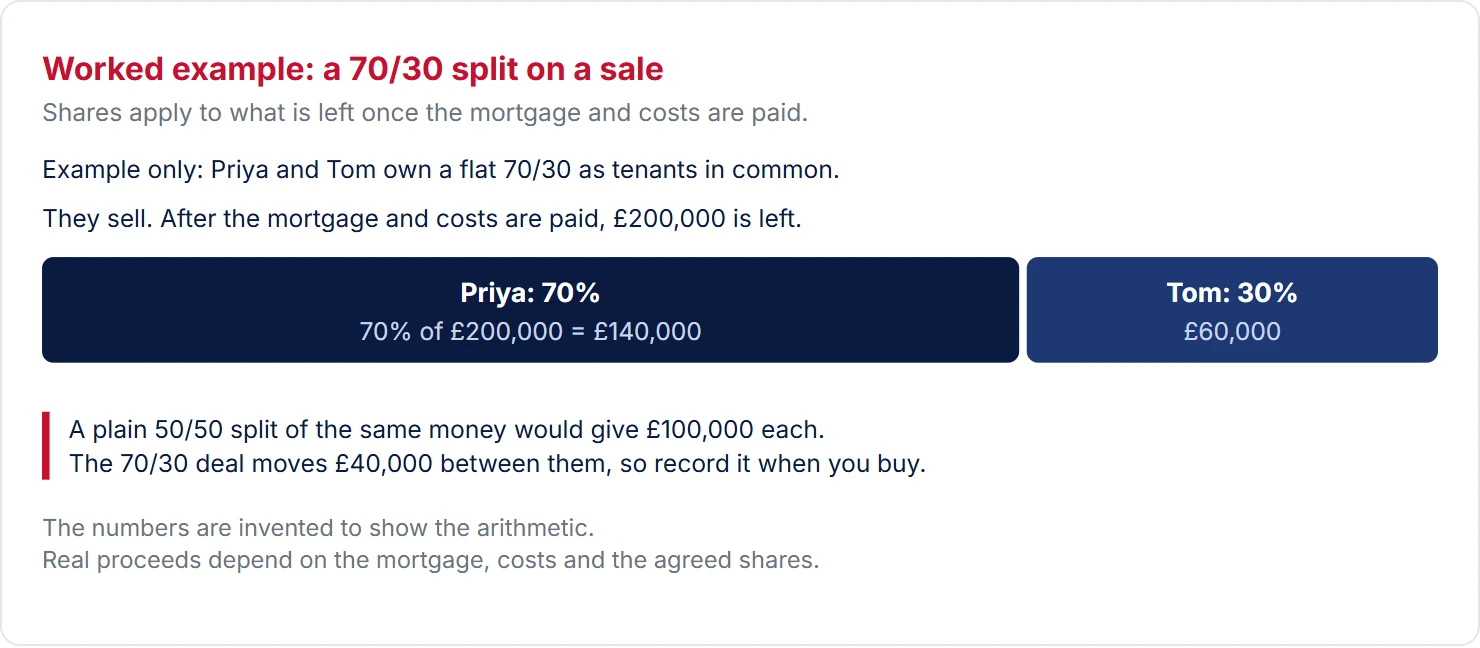
Tenants in common can also hold equal shares. That can be a straight 50/50 split, with each person still free to leave their half by will.
So which is right for you: joint tenants or tenants in common?
No single answer fits every case. It turns on who is buying and on what each person wants to happen if the worst occurs. As a rule of thumb, owners who contribute equally and want the survivor to keep the home outright are usually better off as joint tenants. Owners who contribute unequally, or who want their share to go to someone other than the co-owner, are usually better off as tenants in common.
- A couple who pool everything: joint tenancy is often the simpler fit, because the survivor keeps the home.
- A couple with children from earlier relationships: tenants in common lets each partner leave their share to their own children, if they make a will.
- Friends or siblings buying together: tenants in common, with the shares and exit terms written down.
- A parent helping a child: tenants in common, so the parent’s contribution is recorded in a declaration of trust.
Whichever you choose, decide deliberately when you buy. It is far easier to agree it at the start than to untangle it later. Do not let a default on a form decide it for you.
What is a declaration of trust, and why have one?
A declaration of trust is a written record of what the owners have agreed about the home. A declaration of trust about land must be shown by writing signed by the person declaring it (or by will), so a verbal arrangement is not enough.
A good declaration of trust sets out which share each person owns, who paid what, how costs are shared, what happens on a sale and what happens if one owner wants out. If you hold as tenants in common, it is the document that spells out your shares.
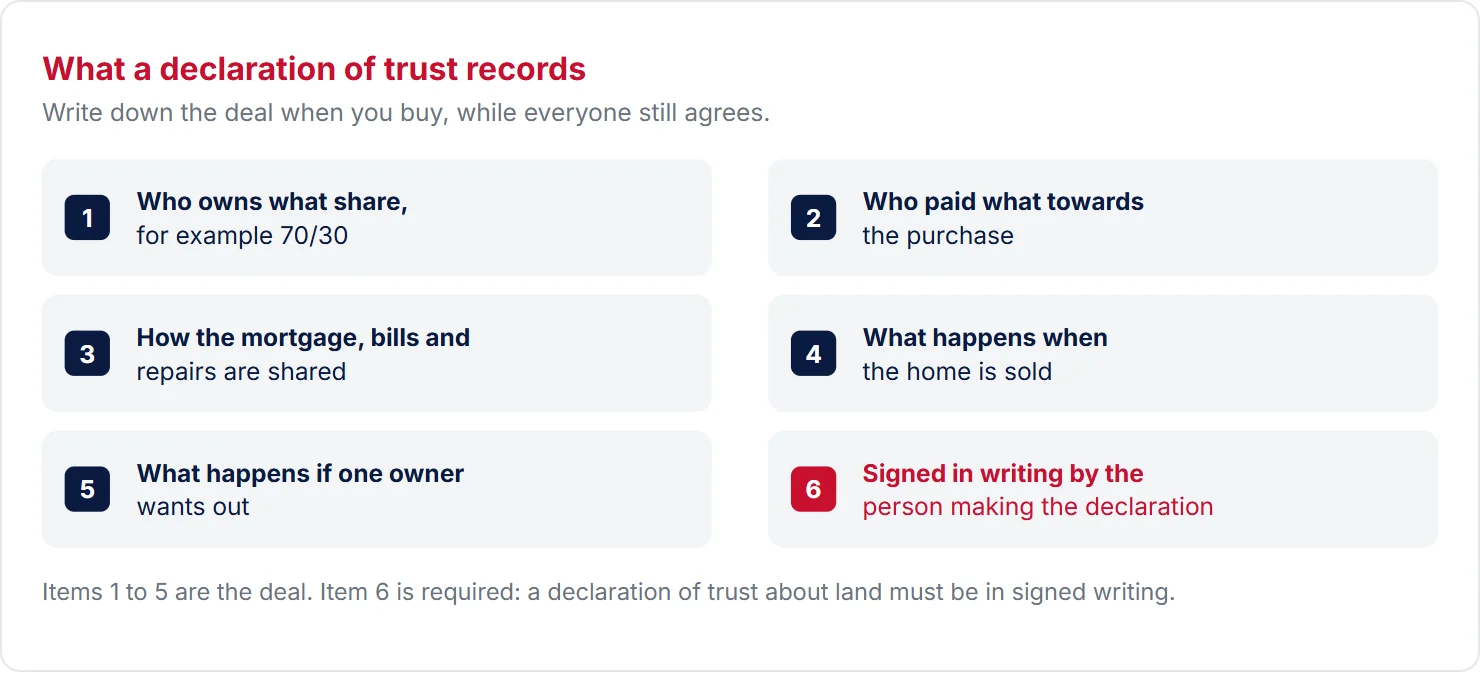
The shares might be worded like this:
The owners hold the property as tenants in common in the following shares: Priya 70% and Tom 30%. These shares reflect the sums each of them has paid, and apply to the proceeds of any sale after the mortgage and costs of sale have been paid.
Without one, you may end up arguing years later about who put in what. If the owners cannot agree on a sale or on their shares, either of them can apply to the court, which can make orders about the trustees’ functions and declare the size of each person’s interest. Going to court is a last resort: it is slow and costly compared with a clear document signed at the start.
Declaration of Trust (Shared Property)
A declaration of trust for two to four people buying together; you edit it to match your own shares and costs.
View template →How do you change from joint tenants to tenants in common?
A joint tenant can sever the joint tenancy by giving the other owner or owners notice in writing; that turns it into a tenancy in common. No agreement from them is needed. At HM Land Registry, the form is SEV.
In practice, the steps are:
- Work out what shares you think are fair and, if you can, agree them with the other owners.
- Give written notice to the other owner or owners.
- Record the shares in a declaration of trust so the new position is clear.
- Make or update your will, because from now on your share goes under it.
Because the other owners do not need to agree, severing can come as a shock to them. Most people tell their co-owners and settle the shares at the same time. If relations are strained, take advice before you send anything.
What is a Form A restriction?
When owners hold as tenants in common, a Form A restriction goes on the registered title. The effect is that money from a sale must be paid to at least two trustees. A trust corporation is the only exception.
In plain terms, if one of two owners dies, the sole surviving owner cannot sell the home alone unless a second trustee is appointed. That can slow a sale down, so it is worth knowing whether you are the survivor or the person waiting to inherit the share.
What if you’re an unmarried couple?
In England and Wales, living together does not give unmarried couples an automatic claim to each other’s property. When you buy together, the form of ownership and the paperwork you sign are what protect each of you.
For most unmarried couples, that comes down to three steps. First, choose tenants in common if your contributions are unequal, or if you want to leave your share to someone else. Then put the deal in a declaration of trust, and make a will. A cohabitation agreement can cover the rest: finances, debts and what happens if you split up.
Cohabitation Agreement
An agreement for unmarried couples that covers the shared home, finances and what happens if you separate.
View template →How many people can go on the title?
The legal title to land can be held by no more than four people. If more than four people buy, the first four named hold the title on trust for everyone. That is why all the buyers should set out their arrangement in a declaration of trust.
Adding or removing an owner later
Circumstances change. A partner moves in, a relationship ends, or a parent steps back from a joint purchase. A transfer of equity agreement sets out the terms you agree when an owner is added or removed. Update the declaration of trust and your wills at the same time.
If an owner might later be unable to make decisions for themselves, a lasting power of attorney allows the people they choose to act on their behalf. We explain how in what is a power of attorney.
A quick checklist before you buy together
- Decide how you’ll hold the property: as joint tenants or tenants in common.
- If you go with tenants in common, agree the shares and put them in writing.
- Sign a declaration of trust that records shares, payments, costs, sale and exit.
- Make or update your will, so your share goes where you want it to.
- Keep the Form A restriction in mind: sale money must go to two trustees.
- Bear in mind that the legal title can carry only four names.
- Get advice if things are complicated or the owners disagree.
Our full range of UK document templates is in thetemplate shop. None of this replaces a solicitor’s advice if your situation is complicated: for example, if the owners disagree, there are children from earlier relationships, or large sums are involved.
Need a template?
Browse our 100+ document templates. Download and edit to suit your needs.
View all templates →