 1 /
4
Overage Agreement (Clawback Deed) for Land — Word & PDF Template
Under an overage agreement made by deed, the seller receives an extra payment after selling the land if, within the overage period, planning permission is granted, development starts or the buyer resells.
Compatible with:
Drafted for England & Wales and checked against current UK legislation. Last reviewed November 2026. How we check


Your card details go straight to Stripe, our payment processor. They are never stored on this site. Checkout takes a minute and needs no account.
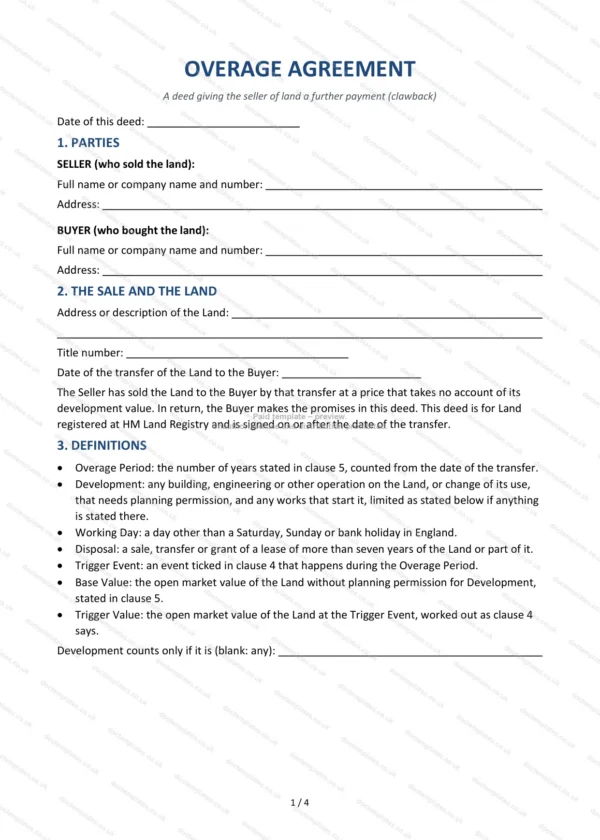
Are you selling land for a price that leaves out its future development value? This overage agreement, also called a clawback deed, lets you share in any later rise in that value. If a trigger event, such as planning permission, happens within the overage period, the buyer makes an overage payment: an extra sum on top of the sale price. The template runs to four A4 pages and includes the deed of covenant for later owners.
Who is this template for?
It is for sellers and buyers of land in England and Wales, such as farmers, landowners and small developers, where the price paid does not yet reflect any development value.
What does the agreement include?
- Parties, the sale and the land: the date of the deed, the date of the transfer and the title number.
- Trigger events you tick: the grant of planning permission, the start of development, or a resale (or a lease of more than seven years), with a definition of what counts as development.
- Overage period and amount: a percentage of the uplift (the rise in value above the base value), or a fixed sum, with optional deductions for planning costs and interest on late payment.
- Payment and valuation: written notice of each trigger, a 20-working-day window to agree the figure, payment dates, and an independent chartered surveyor if you disagree.
- The buyer’s promises: to report planning steps, keep records of the land’s planning history and sales, and not to structure deals to avoid payment.
- Restriction on the register: stops a sale of the land from being registered unless the overage is settled or a deed of covenant is in place. A lender’s mortgage is still allowed.
- Deed of covenant: each new owner signs a promise to the seller before taking the land, so the overage payment binds them.
- Execution as a deed, with witness or second-signatory blocks.
- Schedule: the form of deed of covenant for a new owner.
Scope
This covers land registered at HM Land Registry. Take care when agreeing the amount and triggers, because they decide what is paid.
Format
Download it instantly as an editable Word (.docx) file and a PDF, formatted to A4. It opens in Microsoft Word, Google Docs and LibreOffice; you can tick the boxes with a click in Word and LibreOffice, or by hand on paper.
How to edit the template
- Download the DOCX file after purchase
- Open it in Word, Google Docs, LibreOffice or another DOCX editor
- Fill in the parties' details in the marked fields
- Edit the terms and text to match what has been agreed
- Print it for signing or send it digitally